Swim Meet Snacks: What to Pack Between Events
Swim meets don’t run on a neat snack schedule. Your swimmer might race, wait two hours, then race twice in quick succession. And just as the next event approaches, the banana you packed has suddenly become deeply offensive.
So what should you actually pack? Start here:
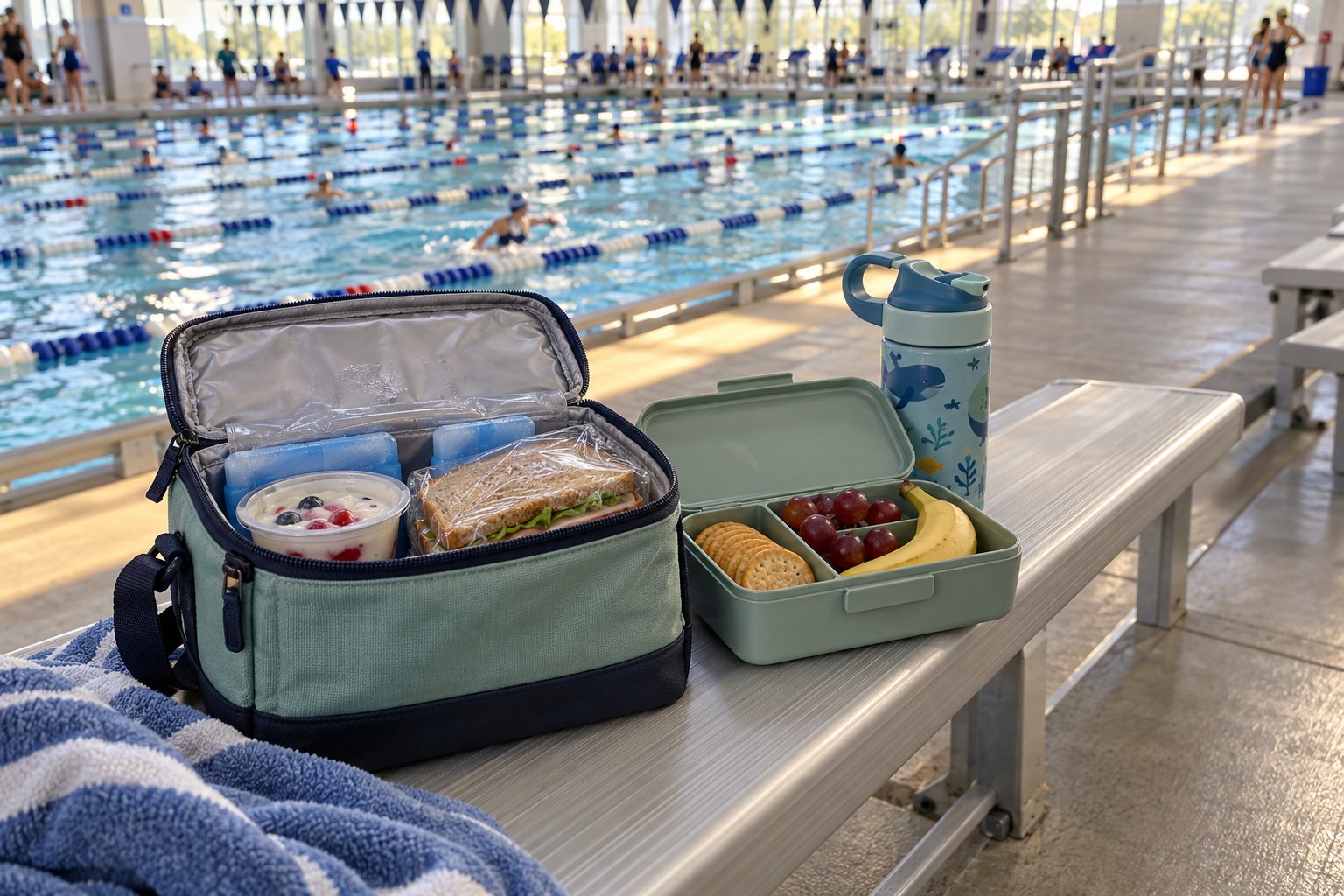
- Water, in a bottle your swimmer can open easily
- A couple of familiar snack choices for shorter gaps
- Something more substantial for a longer session or break
- Appropriate cooling (ice packs or an insulated bag) for anything perishable
- Containers your swimmer can open without help
How much to bring depends on your child and the session. Age, appetite, what they ate earlier and how their stomach handles food before activity all matter. This is practical packing inspiration, not an individual nutrition plan; a doctor or registered dietitian can help with specific needs.
Heading to your swimmer’s first meet? First Swim Meet? A Parent’s Survival Guide walks through the rest of the day.
This post contains affiliate links. If you purchase through these links, I may earn a commission at no extra cost to you. As an Amazon Associate I earn from qualifying purchases.
Choose Snacks Around the Gap Between Events
Start with the heat sheet, then remember that the race time isn’t the only time that matters. Swimmers usually need to report to their coach or to marshalling (where they line up before their heat) ahead of the race, so follow the coach’s instructions for when to head down.
- Shorter gap: a small, familiar, easily tolerated snack if your swimmer is hungry, plus water.
- Longer break: a more substantial snack can make sense, like crackers with cheese or yogurt with cereal.
- Meal-length break: a familiar meal may suit a longer stretch, such as between sessions.
For general guidance, the Canadian Paediatric Society suggests a meal at least 3 hours before an event and a snack 1 to 2 hours before. Treat that as a loose guide, not a rule, because meet schedules shift constantly. Pack a mix and adjust as the session moves.
Easy Options for Shorter Gaps
These swim meet food ideas are small, quick and easy to pack. SickKids’ AboutKidsHealth lists bananas, dried fruit and applesauce cups or pouches among easy pre-exercise options. There’s no universal “best snack,” just what your swimmer likes and tolerates.
- Banana: comes in its own wrapper, but bruises easily, so pack it on top.
- Applesauce pouches: shelf-stable until opened and easy to eat in the stands.
- Crackers or pretzels: inexpensive and easy to portion. Salty snacks can make swimmers thirsty, so pair them with water.
- Dried fruit: compact and shelf-stable, though some kids find it sticky.
- Plain cookies or cereal bars: familiar to many kids. Check labels for allergens every time you buy.
Picky eater? Bring foods they already eat at home. A swim meet isn’t the day to introduce something new.
More Substantial Options for Longer Breaks
When there’s more time, a bigger snack or simple meal may help your swimmer feel settled. Some options need to stay cold:
- Sandwiches or wraps: fillings such as deli meat, cheese, egg or tuna need cooling.
- Yogurt with cereal on the side: yogurt needs cooling; add the cereal just before eating.
- Cheese and crackers: keep the cheese cold.
- Pita and hummus: hummus needs cooling once opened.
- Leftover pasta or rice, if your swimmer likes them cold. Keep these cold too.
Shelf-stable alternatives: a bagel or bread with jam (if team allergy rules allow), crackers, whole fruit, dried fruit or a cereal bar.
Very large or rich portions can feel uncomfortable for some swimmers close to a race. That doesn’t mean avoiding them altogether; familiar, moderate amounts are just often easier.
A Flexible Swim Meet Snack Rotation
Use this chart as flexible packing inspiration, not a meal plan. Your swimmer won’t need every row in one session.
| Situation | Snack idea | Optional add-on | Cooling needed? | Simple swap |
|---|---|---|---|---|
| Short gap, hungry | Banana or applesauce pouch | Water | No | Small box of raisins |
| Short gap, wants salty | Pretzels or crackers | Water | No | Rice crackers |
| Longer break | Cheese and crackers | Grapes | Yes, for cheese | Cereal bar and fruit (no cooling) |
| Longer break, wants soft | Yogurt | Dry cereal on the side | Yes | Applesauce pouch and plain cookies |
| Meal-length break | Familiar sandwich or wrap | Fruit | Usually, depending on filling | Bagel with jam, if allergy rules allow |
On a phone, swipe sideways to see the full chart.
What to Pack It In
The right containers make snacks easier to grab and keep perishables safer. One thing to know: an ordinary compartment box isn’t necessarily insulated or leakproof, so check what each product actually claims.
Bento boxes for organized, accessible portions
A bento box keeps snacks separate and easy to grab between events. Check compartment sizes, whether your child can open the lid, how it’s cleaned and whether wet foods could mix. Small reusable containers you already own work just as well.
For younger swimmers: the Bentgo Kids Bento-Style 5-Compartment Lunch Box is designed for ages 3 to 7. Bentgo lists about 568 mL across five compartments, a leak-proof lid and a top-rack dishwasher-safe removable tray, with hand washing recommended for the outer shell. Older or hungrier swimmers may need more space.
For older swimmers: the Bentgo Pop Leak-Proof Lunch Box is made for ages 8 and up. Bentgo lists 5 cups (about 1,183 mL) of total capacity, three compartments plus a removable divider for a fourth, a lid designed to seal each compartment, and a top-rack dishwasher-safe tray. It measures about 24 x 18 x 6 cm, so it takes more bag space.
Insulated bottles for easy water access
Water is the usual starting point. AboutKidsHealth suggests keeping a water bottle in sight and taking small, frequent sips through the day. Give each swimmer their own labelled bottle, and check whether the venue has a refill station.
Straw-lid option: the Thermos FUNtainer 12 oz Stainless Steel Vacuum Insulated Kids Straw Bottle has a push-button lid, a pop-up straw that’s removable for cleaning and a carry handle. Thermos says it keeps drinks cold for up to 12 hours and isn’t for hot liquids. It’s listed as top-rack dishwasher safe, though hand washing is recommended.
Two-lid option: the HASLE OUTFITTERS 16 oz Insulated Water Bottle is double-wall stainless steel with a spout lid and a straw lid, so swimmers can use whichever is easier. The Amazon listing says it keeps drinks cold for up to 24 hours and is hand wash only.
Small coolers and ice packs for perishables
Health Canada describes 4°C to 60°C as the temperature danger zone and recommends an insulated lunch bag with an ice pack, or a frozen item such as a small water bottle, to keep packed food cold. Advertised cooling or ice-retention times depend on conditions and don’t prove your food is at a safe temperature. When in doubt, throw it out.
Compact option: the PackIt Freezable Classic Lunch Box has freezable gel built into its walls. PackIt says to freeze it for 8 hours or overnight, hand wash the interior and never put it in the dishwasher or washing machine. The listing gives a capacity of 3 litres.
Family-size option: the Arctic Zone Titan Deep Freeze 16 Can Zipperless Hardbody Cooler has a flip-open lid, a removable hard liner with a shelf to keep soft foods from being crushed, and a shoulder strap. The listing gives a capacity of about 12 litres and dimensions of 31 x 20 x 31 cm. Ice packs aren’t included, and it’s bulky for crowded spectator seating.
Already own a lunch bag? An insulated bag with a couple of ice packs works too.
A Simple Night-Before Routine
- Check the session length and estimate the gaps between your swimmer’s events.
- Prepare familiar foods in small, easy portions, and keep anything perishable in the fridge until you leave.
- Freeze ice packs or a freezable bag. PackIt, for example, recommends 8 hours or overnight for its bags.
- Fill or prep water bottles and label them.
- Gather utensils, napkins and a small garbage bag.
After the meet, wash lunch bags and containers following each manufacturer’s instructions. Health Canada recommends washing lunch bags with hot soapy water after each use.
The same idea works for regular training days; see our early morning swim practice guide.
Swim Meet Snack Packing Checklist
- Water bottle, filled
- Two or three familiar small snacks
- One more substantial option for a longer break
- Ice packs or a freezable bag for perishables
- A bento box or small containers your swimmer can open
- Utensils and napkins, if needed
- A small bag for garbage and wrappers
Check the rules first. Teams and venues may have rules about outside food, where you can eat and allergies. Eat only in permitted areas, never on restricted pool decks. No snack is allergy-safe for everyone, so check ingredient labels and confirm individual needs, especially for shared snacks.
Need the non-food essentials too? Our Swim Meet Packing List for Parents covers everything else that goes in the bag.
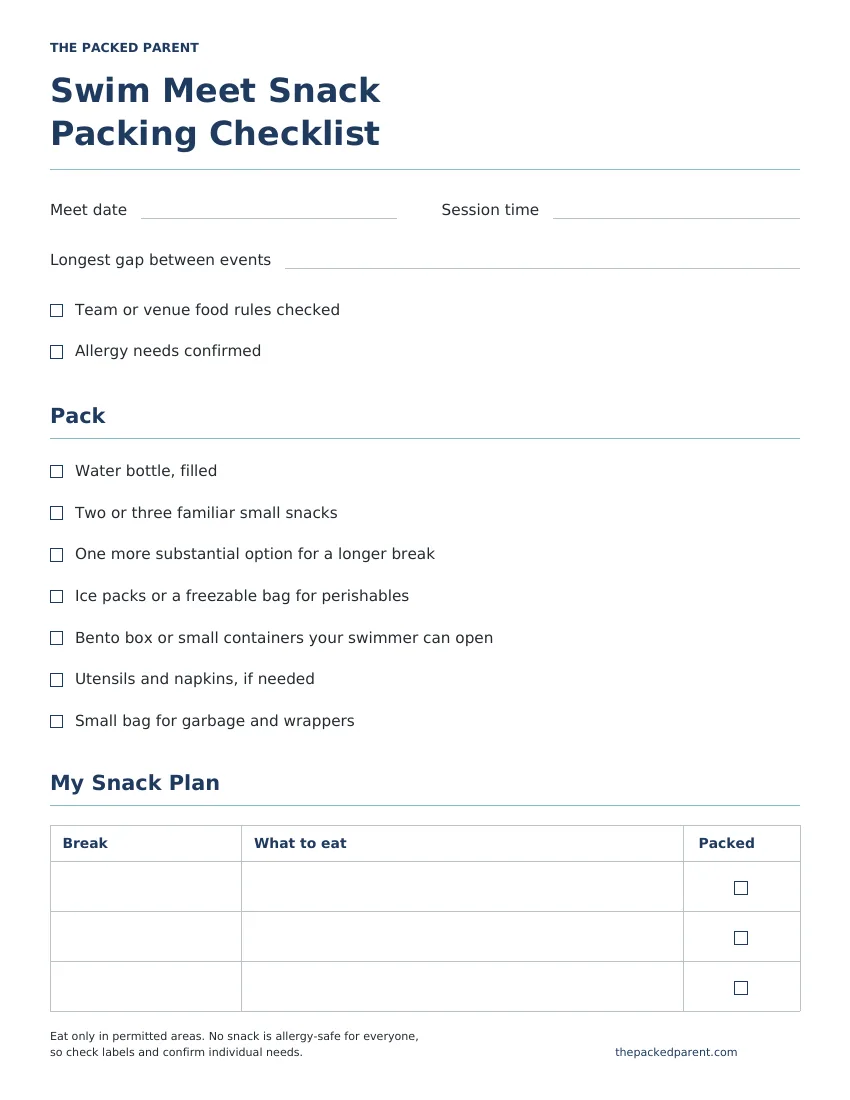
Want it on paper? Grab the free printable swim meet snack packing checklist, with space for meet times, the packing list and your snack plan for each break.
Common Mistakes to Avoid
- Forgetting cooling for perishable foods.
- Packing only one large meal. Gaps vary, so smaller options are more flexible.
- Trying unfamiliar foods before racing. Stick with what your swimmer knows.
- Relying on the concession stand. It may be closed, busy or limited.
- Sharing water bottles. Give each swimmer their own, labelled bottle.
Swim Meet Snacks FAQ
What if my swimmer is a picky eater?
Pack foods they already enjoy. Familiar beats perfect.
Do swimmers need sports drinks?
Not automatically. Water is the usual starting point. AboutKidsHealth notes that water alone may not be enough after about an hour of activity or in hot, humid conditions, so ask your coach or a health professional if you’re unsure. Energy drinks are different: Health Canada says they’re not recommended for children.
Do I need a cooler?
Only if you’re packing perishable foods such as yogurt, cheese or sandwich fillings. Shelf-stable snacks don’t need one.
How do I plan around uncertain race times?
Pack a mix of small snacks and one bigger option, and follow the heat sheet and your coach’s instructions as the session moves.
Are there rules about food at swim meets?
Often. Check the meet package, venue rules and your team’s allergy policy before you pack, and eat only in permitted areas.
Keep Swim Meet Snacks Simple
The best snacks for swimmers are familiar, flexible and stored properly. Pack a few options, keep water close and let the gap before the next event guide what comes out of the bag.
Have a hockey player too? Our Rink-Side Snacks and Hydration guide covers game-day food for the rink.
Sources
- Canadian Paediatric Society, Caring for Kids: Nutrition for your young athlete
- SickKids AboutKidsHealth: Sports nutrition and supplement safety
- Health Canada: Safe school lunches
- Health Canada: Safe food storage
- Bentgo: Bentgo Pop Lunch Box product page
- Health Canada: Caffeinated energy drinks
- PackIt: Frequently Asked Questions
Product details were checked on October 11, 2026, and may change.