First Swim Meet? A Parent’s Survival Guide
This post contains affiliate links. If you purchase through these links, I may earn a commission at no extra cost to you. As an Amazon Associate I earn from qualifying purchases.
Your child’s first swim meet is exciting and a little confusing: whistles, cheering, announcements you can’t quite hear, paperwork and a lot of waiting for races that last under a minute.
The good news: you don’t need to understand every rule before the first race. This first swim meet guide explains what usually happens, where you’ll be and how to support your swimmer.
One important note before we start: procedures vary by club, age group, venue and meet. Your coach’s instructions and the meet package always come first.
If You Remember Only Five Things
- Read the meet information. The meet package and club emails cover times, location and spectator rules.
- Follow the club’s arrival time. It’s set so swimmers are ready for warm-up.
- Know where your swimmer meets their coach. Usually a team area on deck or a spot the club announces.
- Keep track of their events. Note event, heat and lane numbers.
- Leave room for downtime and schedule changes. Meets can run ahead or behind.
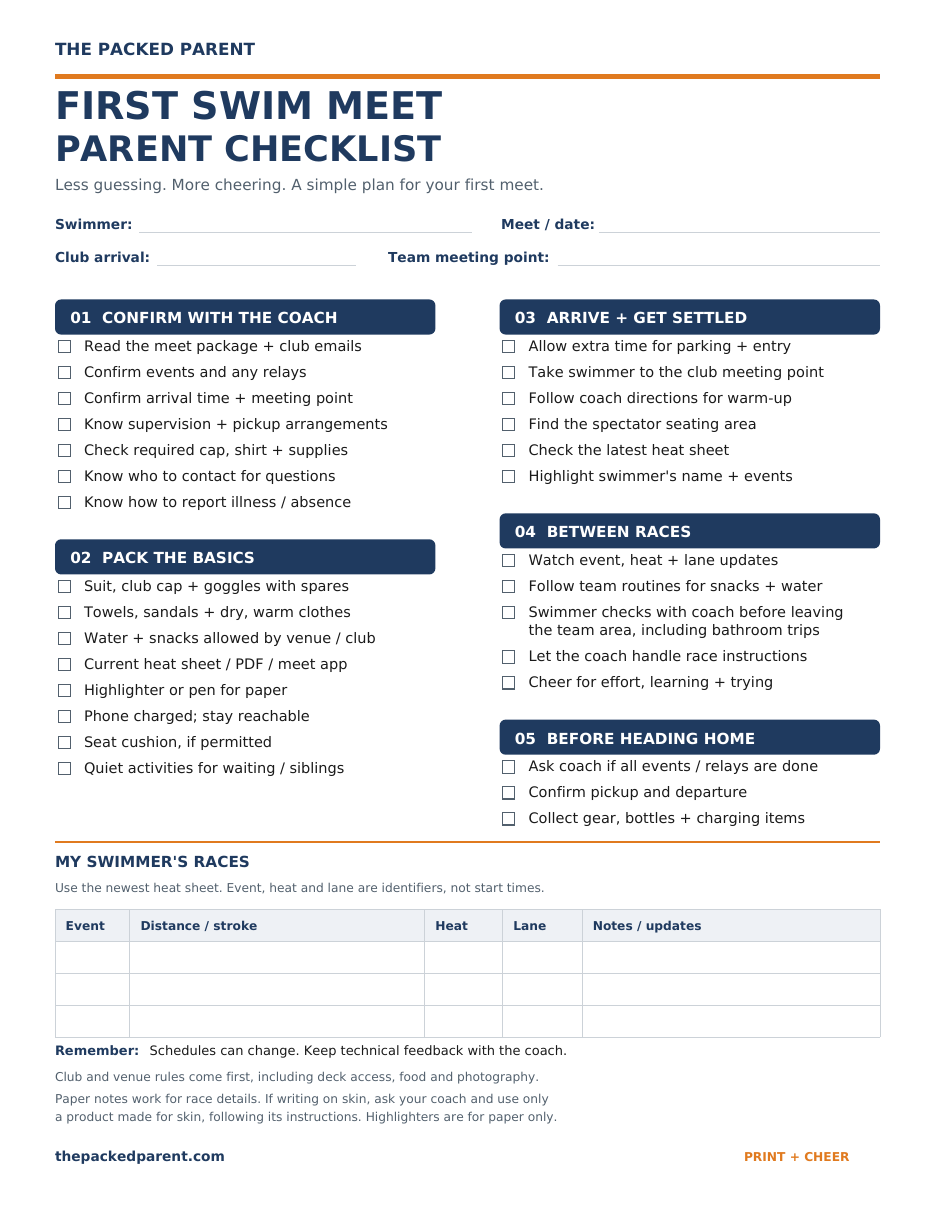
Want it on paper? Grab the free printable first swim meet parent checklist. It walks you through the day and includes a race tracker for writing down your swimmer’s events, heats and lanes.
Before Meet Day: What to Confirm With the Coach
A quick message or a look through club emails answers most questions. Confirm:
- Entries. Which events is your swimmer entered in? An event is a single race, such as the 50 m freestyle for one age group.
- Arrival time and team meeting point. Where and when should your swimmer report?
- Supervision. Who looks after swimmers on deck, and when can you pick them up?
- Supplies. Does the club want a team cap, shirt or anything else?
- Absences. If your swimmer can’t attend or gets sick, how should you tell the coach? Withdrawing from an event is called a scratch, and some meets have scratch deadlines.
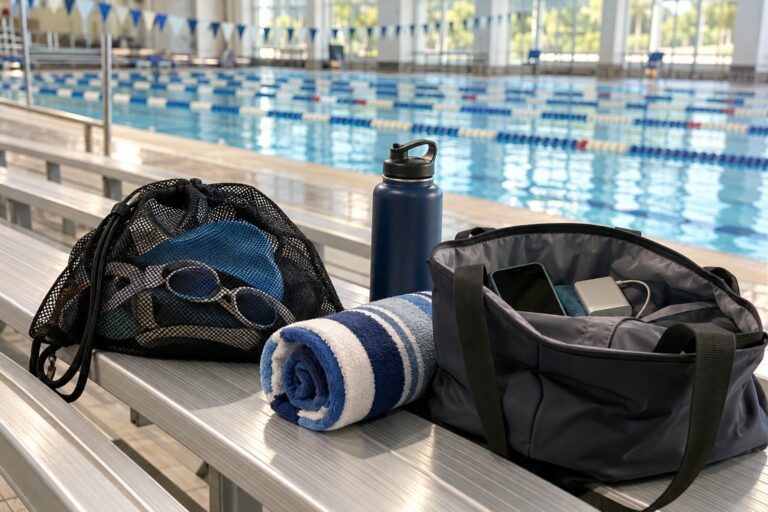
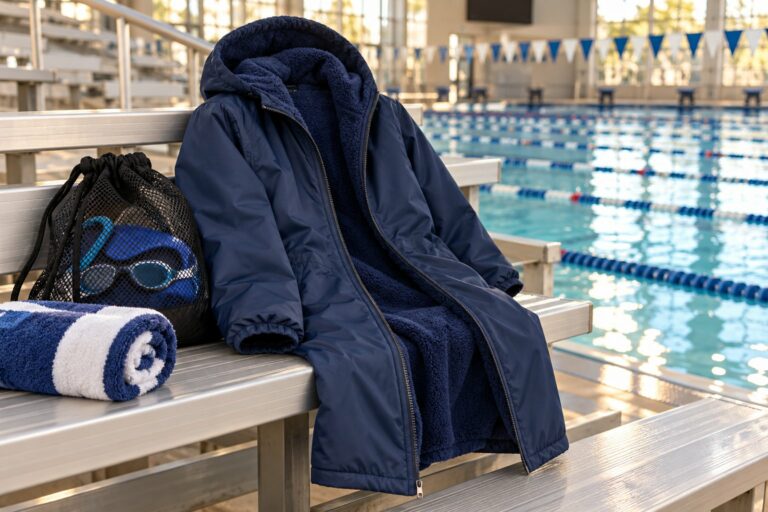
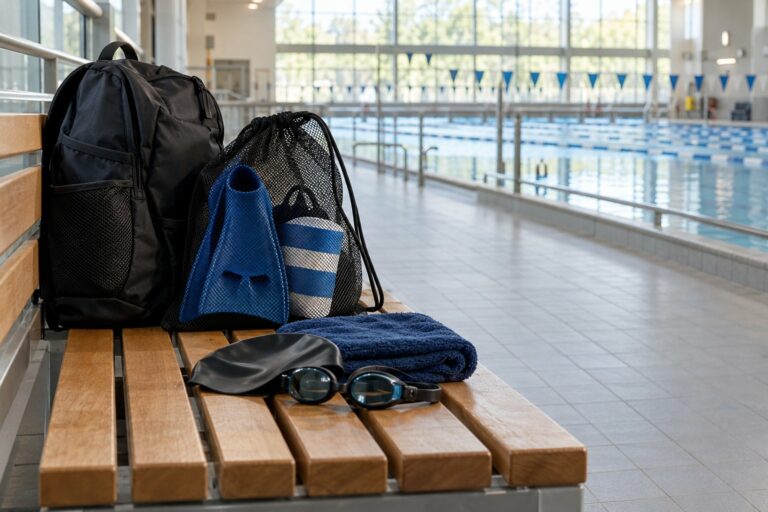
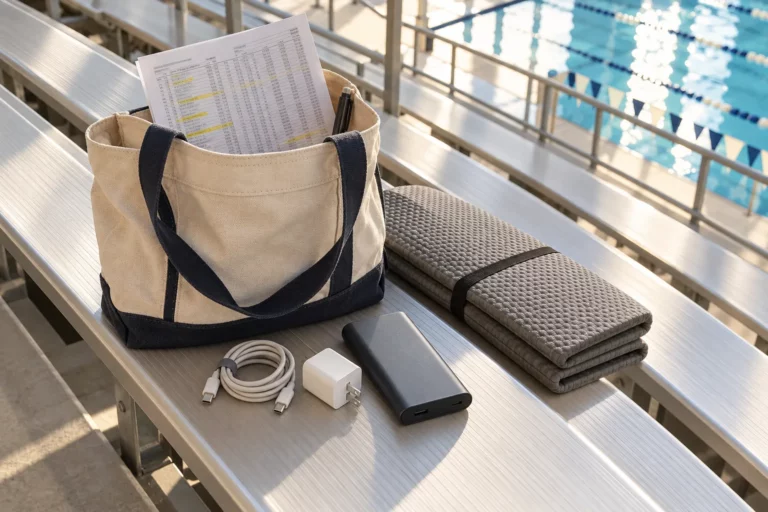
For gear, keep it simple: swimsuit, cap, goggles (plus spares), towels, sandals, warm clothes, a water bottle and snacks. Our [ADD INTERNAL LINK: Swim Meet Packing List for Parents] covers the full checklist.
The night before, work through our swim meet packing list.
What Happens When You Arrive
Parking and spectator entry. Leave extra time for parking. Spectators usually sit in bleachers or an upstairs viewing gallery, and some meets charge admission or sell heat sheets at the door.
Your swimmer’s team area. Swimmers normally change in the change room, then head to the pool deck to find their coach and team. Many meets limit the deck to swimmers, coaches, officials and volunteers, so parents generally say goodbye at the change room or spectator entrance.
Warm-up. Before competition starts, swimmers loosen up in the pool with their coach while you settle into the stands.
Who does what:
- Parents: get your swimmer there on time with their gear, track events from the stands, stay reachable and handle snacks and pickup.
- Coaches: run warm-up, give race instructions, answer technical questions and talk to officials if needed.
If you have questions on the day, ask your coach, team manager or club volunteer according to your club’s arrangements. Please don’t go behind the blocks, walk onto the deck or approach officials during the meet.
How to Read a Heat Sheet
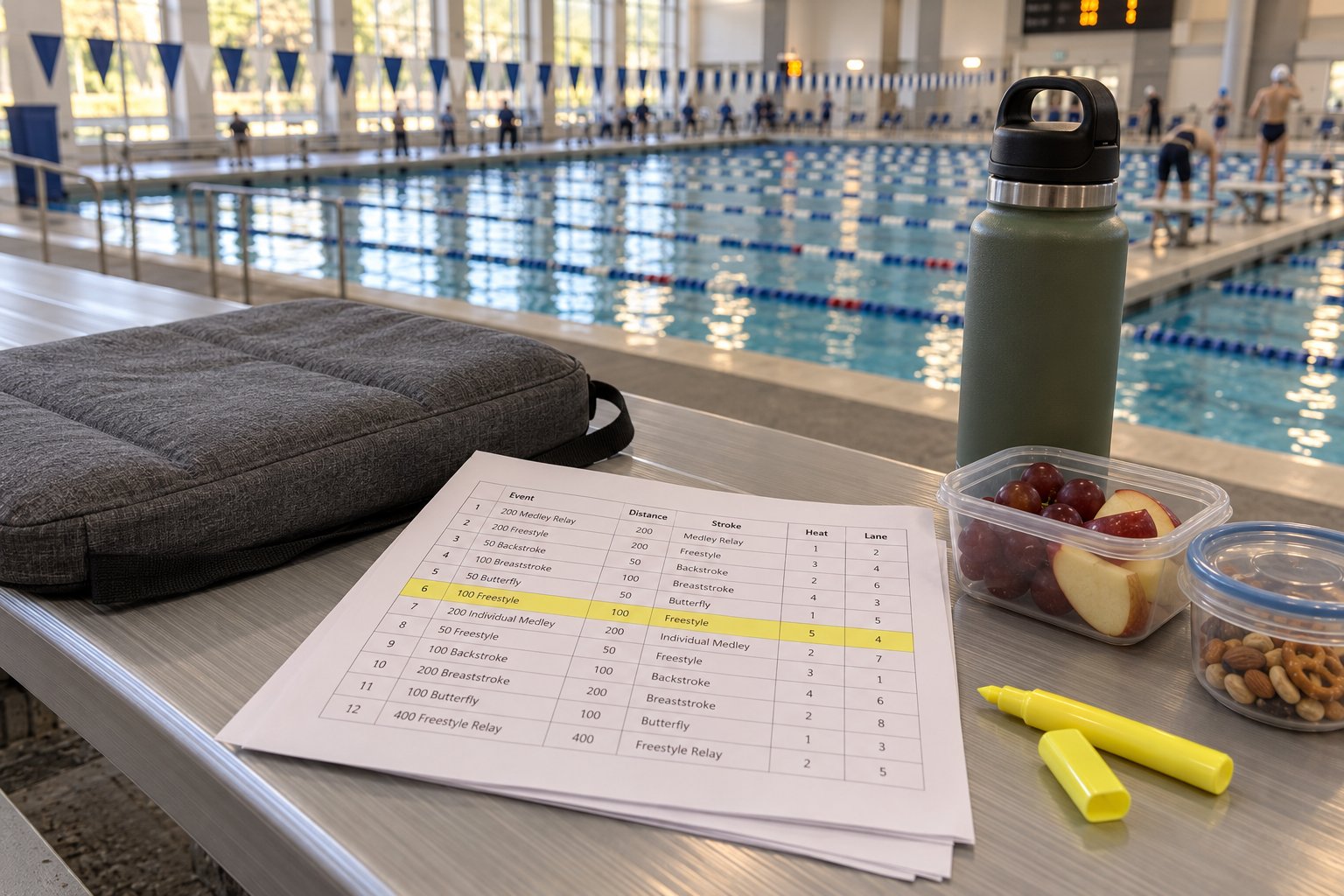
At first, the heat sheet can look like a spreadsheet that learned to swim. It’s simply a list of every race and who’s swimming in it. You may get it printed, as a PDF or through a meet app.
Here’s a fictional example of how your swimmer’s entry might appear:
Fictional example
Event 7 | 50 m Freestyle | Heat 3 | Lane 4
- Event 7: the race number. Events run in order.
- 50 m Freestyle: the distance and stroke.
- Age group: usually shown in the event title, such as “Girls 9–10.”
- Heat 3: the group of swimmers racing together. Big events are split into several heats.
- Lane 4: your swimmer’s lane in that heat.
You may also see a seed time, the entry time used to place swimmers into heats. New swimmers often show NT (no time).
These numbers are race identifiers, not a start time. Formats vary, and heat or lane assignments can change after scratches. If the meet posts an updated heat sheet or uses an app, follow the newest version.
Markers vs. Highlighters: Keeping Track of Races
Highlighters are for paper. Highlight your swimmer’s name and events on the heat sheet so you can find them quickly. The Sharpie Pocket Highlighters, Narrow Chisel Tip, Assorted Colours, 4 Count are slim enough for a bag pocket and include four colours, handy if you’re tracking siblings. They’re ordinary stationery and are not meant for skin.
Writing on skin is a club-by-club practice. Some clubs encourage swimmers to write event, heat and lane numbers on their arm or hand. If yours does, use only a product made for skin, follow its instructions and check with your coach. Don’t use an ordinary permanent marker.
One option made for skin is BodyMark by BIC Temporary Tattoo Marker, Henna Vibes, 3-Count. BIC describes BodyMark as cosmetic-quality, says it washes off with soap and water, and notes it hasn’t been tested on sensitive skin. Test a small area first.
Prefer to skip ink on skin? A folded index card or sticky note with event, heat and lane numbers in your swimmer’s bag works too, and their coach will help them get to the right place.
Between Races: What to Expect
There’s often a long gap between races, so expect to wait. Your swimmer should stay with the team and follow the coach’s directions, including when to head to marshalling, the area where volunteers line swimmers up in the right heat and lane before their race.
Meanwhile:
- Check for updates on the heat sheet, announcements or meet app.
- Stay reachable in case the coach or your swimmer needs you.
- Offer snacks and water at times that suit the team’s routine.
- Remind your swimmer to tell their coach before leaving the team area, including for bathroom breaks.
- Bring quiet activities for siblings and yourself.
Every swimmer and club is different, so follow your coach’s guidance on warm-up, food and drinks rather than a set schedule.
Planning food between events? See swim meet snacks.
The Parent Comfort Kit
Bleachers get hard after a few hours, and most have no back support. A folding stadium seat can help if it fits the seating and the venue allows it. The VIVOHOME Ultra-Compact Folding Stadium Seats with Back Support, 2 Pack have a padded seat and back, a cup holder, a mesh pocket and hooks that attach to the bleacher. The listing says each seat folds to about 41 x 18 x 10 cm and the pair weighs about 4.9 kg, so think about the walk from the parking lot. Seats with backs take more room, so make sure yours won’t block the view for people behind you.
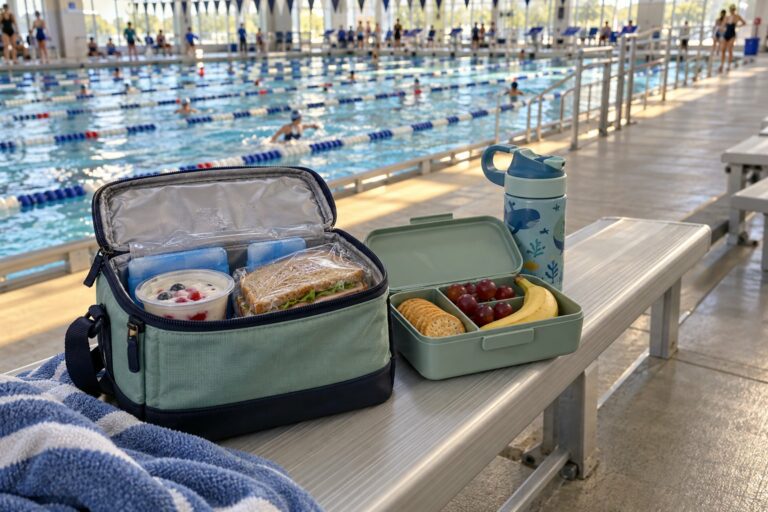
For snacks, check the venue’s outside-food rules and your club’s allergy policies first. Small reusable containers keep snacks tidy in the stands. The Sistema To Go Mini Bites Snack & Dip Food Containers, 130 mL, 3 Pack suit small portions, while the Sistema Lunch Food Storage Containers, 400 mL, 3 Count hold more. Both are listed as top-rack dishwasher safe.
| Item | Why it helps | What to check | Simple alternative |
|---|---|---|---|
| Highlighter | Spot your swimmer’s events fast | Paper only; not for skin | Pen or pencil |
| Skin-safe marker | Some swimmers like race details on their arm | Made for skin; club practice; instructions | Paper note in their bag |
| Stadium seat or cushion | Comfort and back support on bleachers | Venue rules, bleacher fit, weight, view behind you | Folded towel or jacket |
| Snack containers | Tidy, portioned snacks | Food rules, allergy policy, washing | Containers you already own |
If your pool runs warm, see how to survive a hot, humid pool deck. For affordable add-ons, see swim mom bag essentials under $25.
Supporting Your Swimmer
Keep support calm and specific. Instead of focusing on times or places, try:
- “I loved how hard you kicked at the end.”
- “What was the most fun part?”
- “I’m proud you tried something new.”
Leave technical feedback to the coach, who knows what your swimmer is working on.
If your swimmer is disqualified. A DQ (disqualification) means an official saw a rule broken, such as an incorrect turn or stroke, so that swim’s time doesn’t count. DQs are common at first meets. If your swimmer is upset or confused, encourage them to ask their coach for a clear explanation.
A Flexible Meet-Day Timeline
Every meet is different, so use these stages as a guide, not a schedule:
- The night before: reread the meet package, pack the bag and check your swimmer’s events.
- Arrival: arrive at the time your club sets, drop off your swimmer and find a seat.
- Warm-up: swimmers warm up with their coach; you settle in and find your heat sheet.
- First race: watch for your swimmer’s event and heat. Exact start times are estimates only.
- Between races: wait, cheer, snack and keep an eye on updates.
- Departure: check with the coach before leaving, gather belongings and head home.
Common First-Meet Mistakes
- Assuming event numbers are times. Event 7 doesn’t mean 7 o’clock.
- Following an outdated heat sheet. Scratches can shift heats and lanes.
- Leaving without checking with the coach. Your swimmer may have another event or a relay.
- Expecting every result immediately. Results may be posted on a wall, online or in an app, and can take a while to appear.
First Swim Meet FAQ
How long does a swim meet last?
It varies; many sessions last a few hours plus warm-up. Check the meet package.
Can parents go on the pool deck?
Usually not. Ask your club about any exceptions.
Do I need a printed heat sheet?
It depends. Some meets sell printed copies; others use PDFs or apps.
What if my swimmer misses a race?
Talk to the coach, who knows how the meet handles it.
Do parents have to stay for the whole session?
It depends on your team’s arrangements and your swimmer’s age. Confirm supervision and pickup with the coach beforehand.
Can I take photos?
Check the meet and venue rules. In Ontario, for example, Swim Ontario prohibits phone use, photos and video in change rooms and washrooms, and from behind the blocks except for the official photographer.
A Learning Day for the Whole Family
Your first swim meet is a learning day for everyone. Read the meet information, follow the coach’s lead and enjoy the moment your swimmer dives in. By the second meet, that heat sheet will make a lot more sense.